
How does the Spot Market work?
A beginners guide to the National Electricity Market's Wholesale Spot Price. ..with resources to dig deeper...

The spot market is just one part of the electricity system—but it’s the central coordinating mechanism. It’s the thing that ultimately decides:
who generates
how much they generate
and what price gets paid
Everything else—contracts, hedges, policies—sits around it.
So this lesson focuses on the spot market at the core. We delivered this in person (video below) and you can sign up to future online webinars through our mailing list.
Read on if you missed the lesson, prefer to read, or just want to study the slides in more detail…
Locating the Spot Market
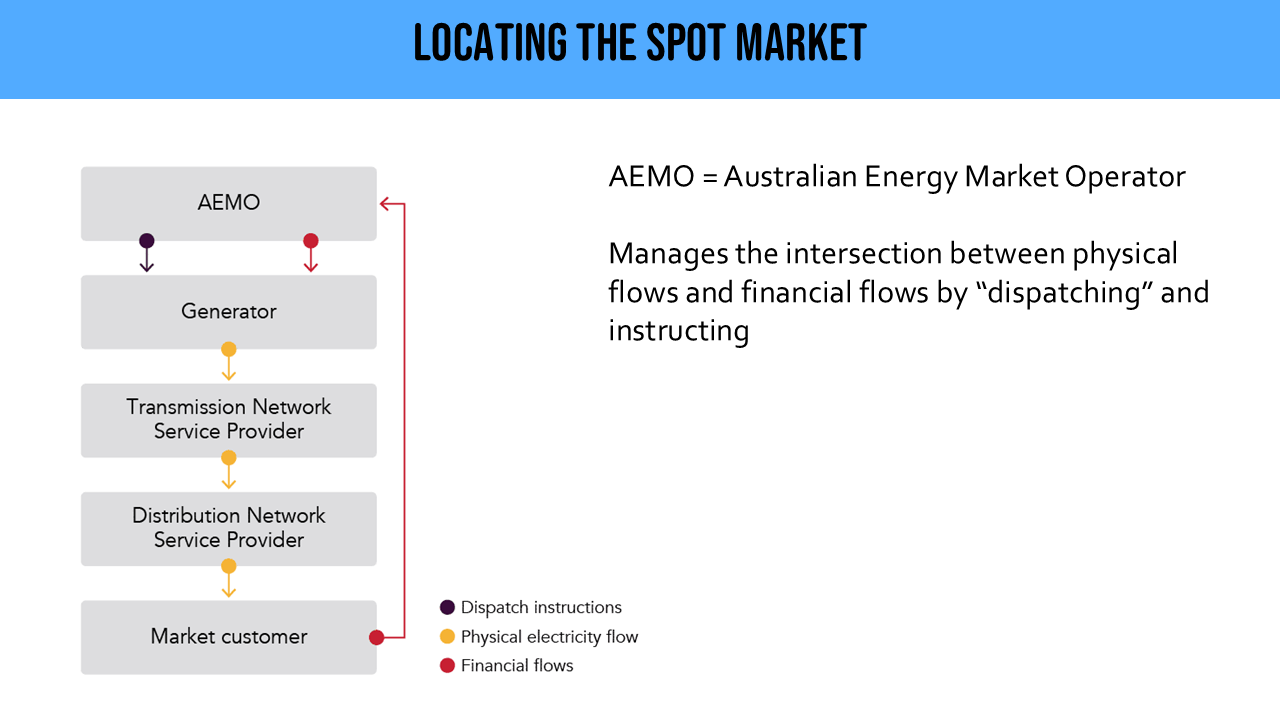
image from AEMO learning
To understand the spot market, you need to understand the role of the Australian Energy Market Operator (AEMO).
AEMO sits in the middle of the system and manages the intersection between physical electricity flows and financial flows
On the physical side:
generators produce electricity
it flows through transmission and distribution networks
and ends up with customers
On the financial side:
retailers pay AEMO
AEMO pays generators
But the key thing AEMO does is manage dispatch.
It’s rules, automation and oversight decides:
who gets to generate
and how much
Every five minutes. And this happens in five regions simultaneously:
Queensland
New South Wales
Victoria
South Australia
Tasmania
Five Markets, Not One
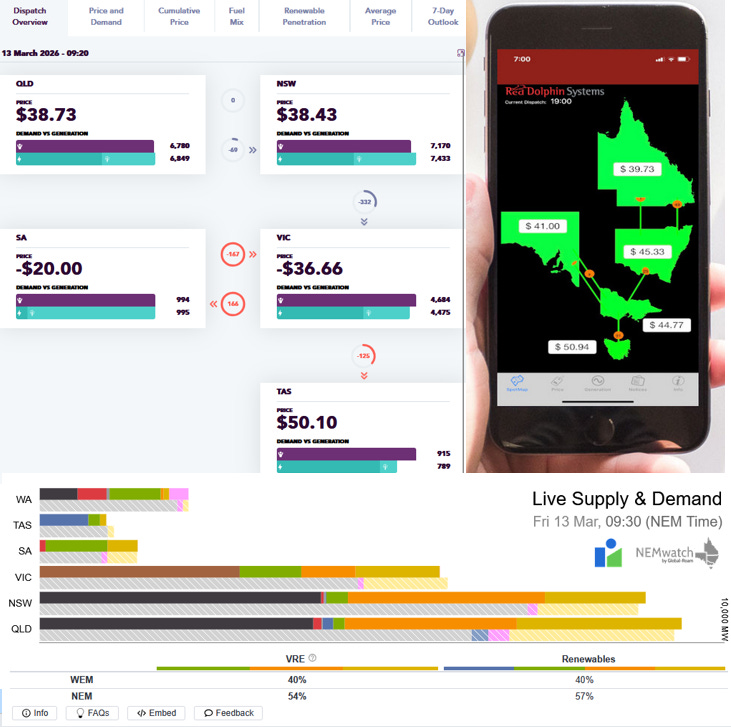
you can watch this in real time on the AEMO dashboard, on Apps such as PocketNEM and on other online sources like NEMWatch
Each region has its own price.
But those prices are not independent. Transmission lines interconnect each region.
The Role of Transmission
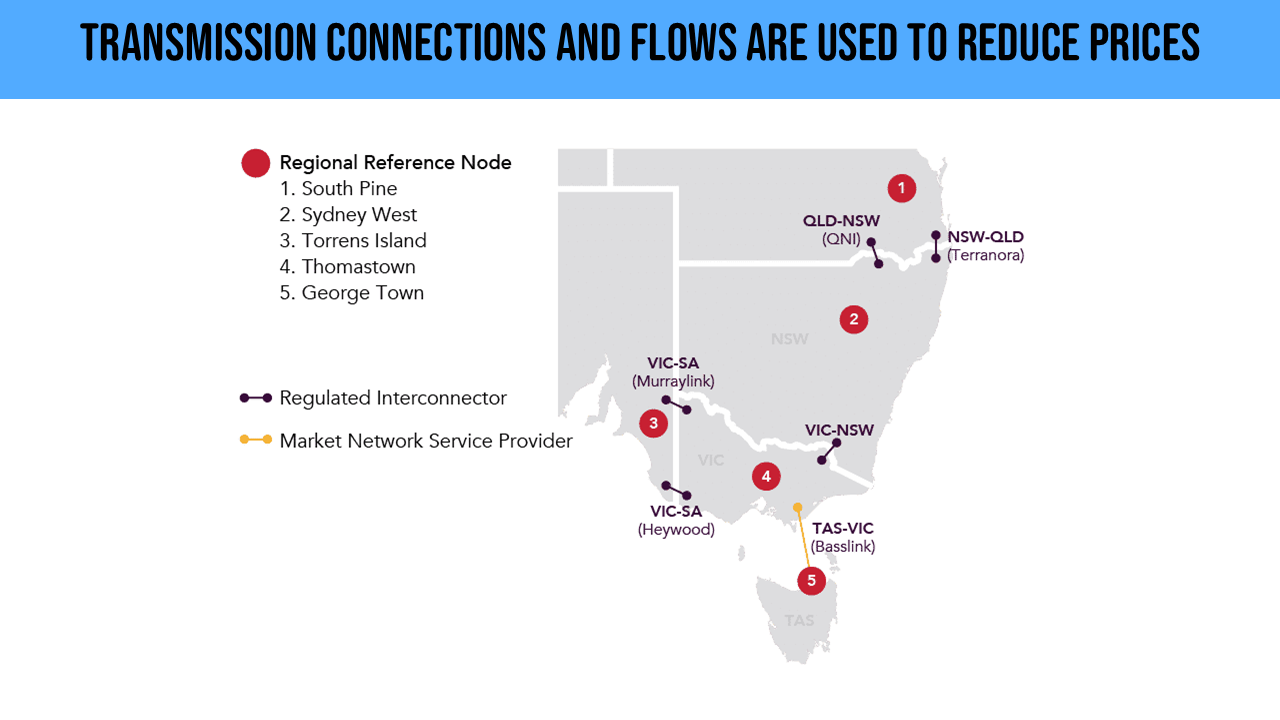
image from AEMO learning
Transmission links allow surplus energy in one region to flow into another
Which means cheap power in one place can pull down prices somewhere else
Sometimes you’ll see one generator in one region effectively setting the price across multiple regions. It happens only when there is spare capacity in each transmission line and its an important feature of the NEM.
That’s transmission doing its job.
There is some nuance in how prices can flow into different regions. AEMO prices are based on something called a regional reference node.
The node locates the price for that region but:
losses occur across the network
distance matters
So prices vary slightly depending on where you are to adjust for losses between the node and your location.
What Kind of Market Is This?
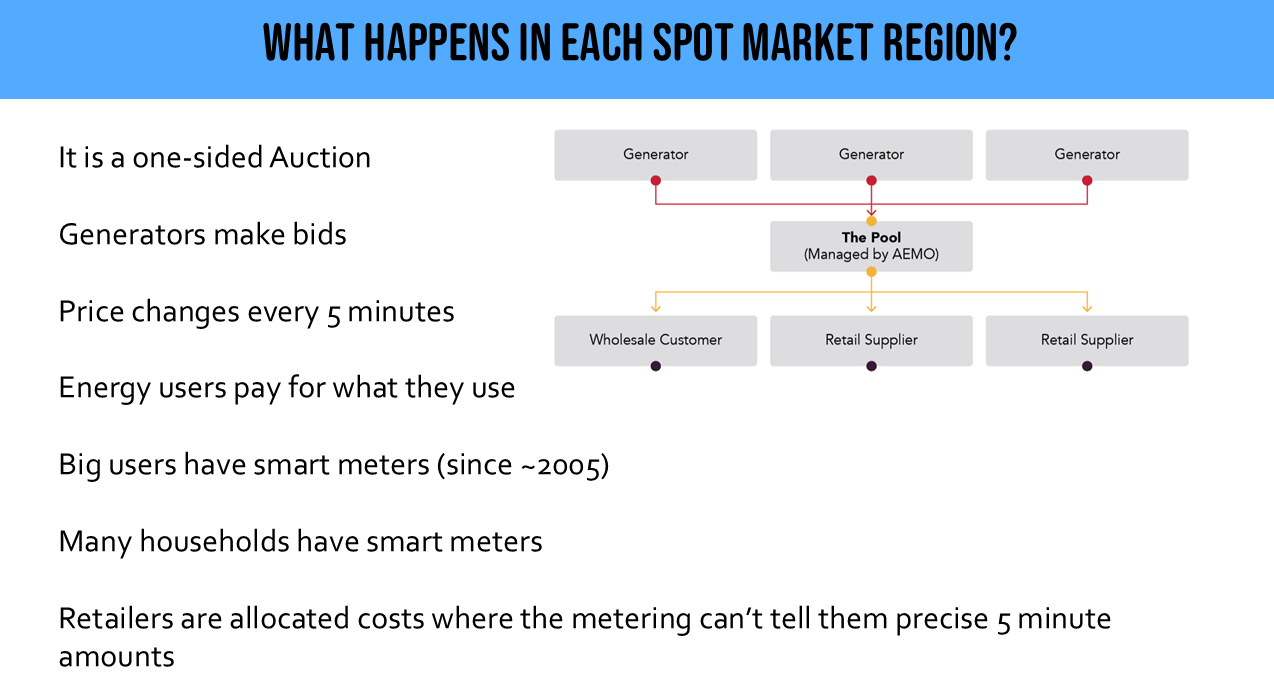
image from AEMO learning
The spot market is a one-sided auction
AEMO determines how much energy is needed
Generators bid to supply that amount
Demand doesn’t actively bid in real time
This means generators compete but demand is largely passive.
Every five minutes price is set and dispatch happens.
In another webinar we will cover some of the mechanisms used in secondary markets (hedges etc.) to allow retailers to manage their risks. We will also have a deeper look at the few mechanisms that big consumers, batteries and other “demand side” actors have to bid into the market**1.
In practice, this means most energy users are not participating at the moment the price is set. They respond later through their retailer or through tariffs, rather than directly in the dispatch process. That’s what makes it “one-sided”—supply competes in real time, while demand is mostly represented indirectly.
Why Metering Matters
This system only works because of measurement.
Large users have had smart meters since ~2005 and households are increasingly getting them now.
When retailers only know how much customers use on a 90 day basis, they are allocated costs based on a load profile that their customers are assumed to use. The load profile (known as the Net System Load Profile) is based on what is left after all the smart meter data has been deducted.
Interestingly retailers like AGL and Origin started rolling out smart meters at their own cost so it is possible that more precise charging works in their favour.
Nuance we didn’t cover in the webinar:
stay tuned for future webinars**
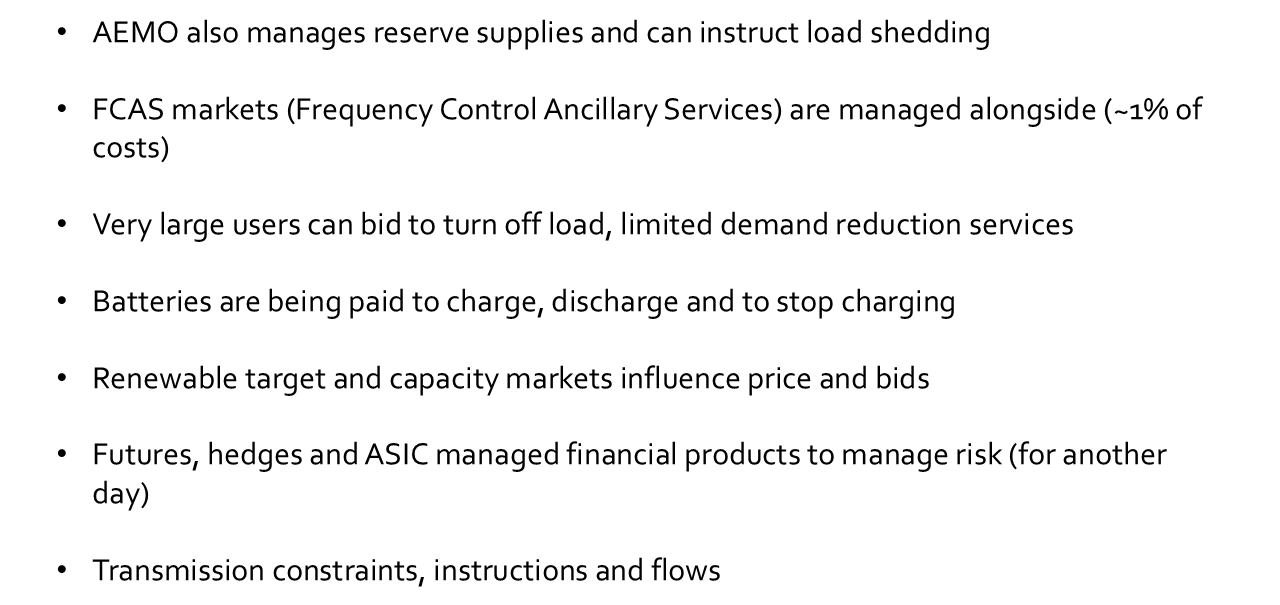
There’s a lot going on around the edges which I didn’t cover:
AEMO manages reserves
It can instruct load shedding
It runs FCAS markets (frequency control ancillary services)
There is demand-side participation
Batteries are paid to charge, discharge, and even to stop charging
These mechanisms are all coordinated through the same dispatch process, so AEMO needs to understand what each participant is doing at any moment.
…please let us know in the comments if you are interested in diving deeper into any of these details**.
The Spot Market Sets the Tone
Even though:
there are contracts
there are hedges
there are financial markets
there are additional markets like capacity markets
there are additional mandates and targets like the renewable energy target
The spot market still sets the reference price for everything.
This is true globally—not just in Australia. Even when the spot market is only part of a wider system of contracts and financial arrangements, it still acts as the central reference point for price. Participants use it to understand what electricity is worth, and other markets tend to anchor themselves around it.
Brett Christophers talked to the Energy Nerds Book Club about his book, The Price is Wrong, and talked about these wholesale markets working badly for renewables in many countries. Even when spot markets with this design are smaller parts of the energy ecosystem they still seem to have a central price-setting effect on other energy trading mechanisms.
The Timeline: How It Actually Works
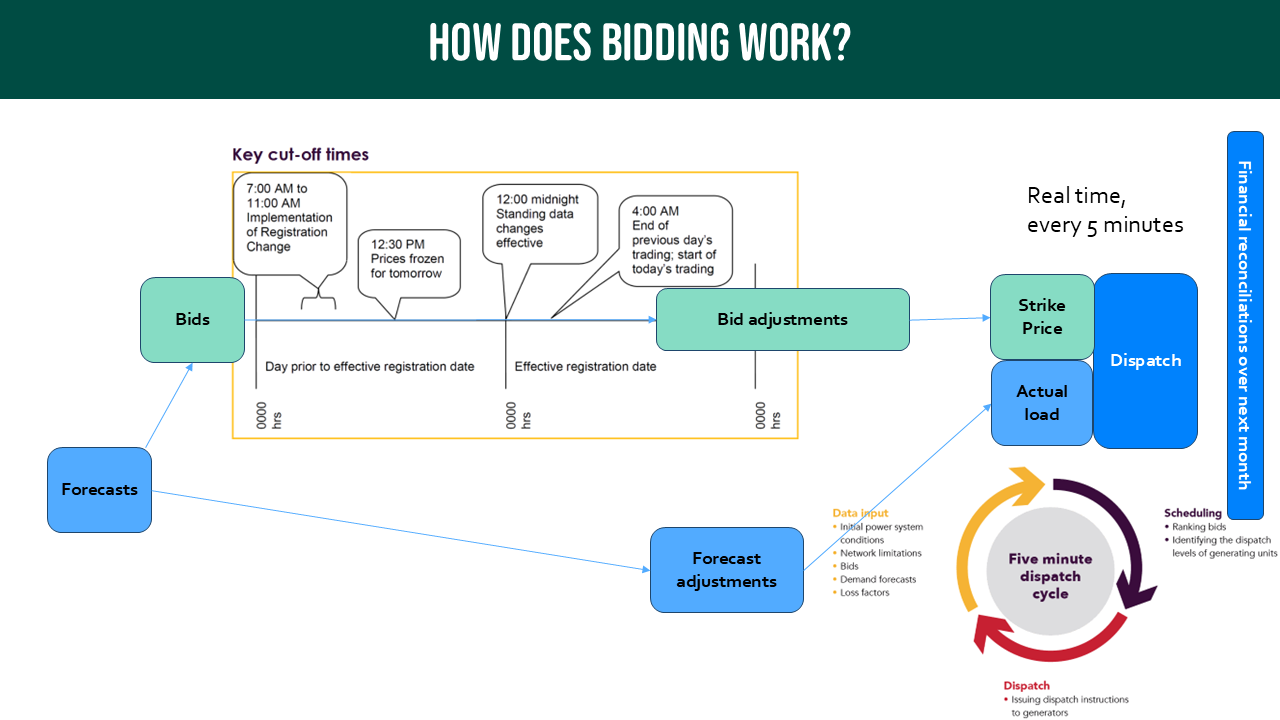
Bidding and forecasts start well before the moment of dispatch.
Long before the day:
AEMO forecasts months ahead
then weeks
then days
Day ahead:
generators submit bids for every 5-minute interval in the following day. You can see in the slide above (drawn from AEMO learning) some of the key times in each day when prices are set and trading starts.
Closer to real time:
forecasts update
bids can be adjusted
Forecasts and bids are both updated right up to dispatch, and those updates can materially change which generators are selected and what price is set.
I didn’t go into detail about this but let me know if you’d like to explore the bidding rules and bidding behaviour more deeply. There is oversight by regulators, generator’s competitors and data analysts leading to formal reports and internet commentary about whether the market is working as it should.
As an aside, the NEM wholesale market review, commonly called the Nelson review because it was led by Tim Nelson, highlighted fixes for short, medium and long term trading in the wholesale spot and secondary markets. These reforms are underway.
At the moment:
price is set
dispatch happens
actual demand replaces forecast
simultaneously across five regions with flows between regions included in the algorithms.
After:
financial settlement can take weeks
In the next few slides, I drill down into the mechanisms of forecasting, the merit stack and the arrival at the strike price.
This timing matters. Retailers need to have enough capital in place to participate in the market and manage these payment cycles, and smaller retailers have struggled with this in practice. It is one of the reasons participation in the market is not evenly distributed.
It All Starts With Forecasting
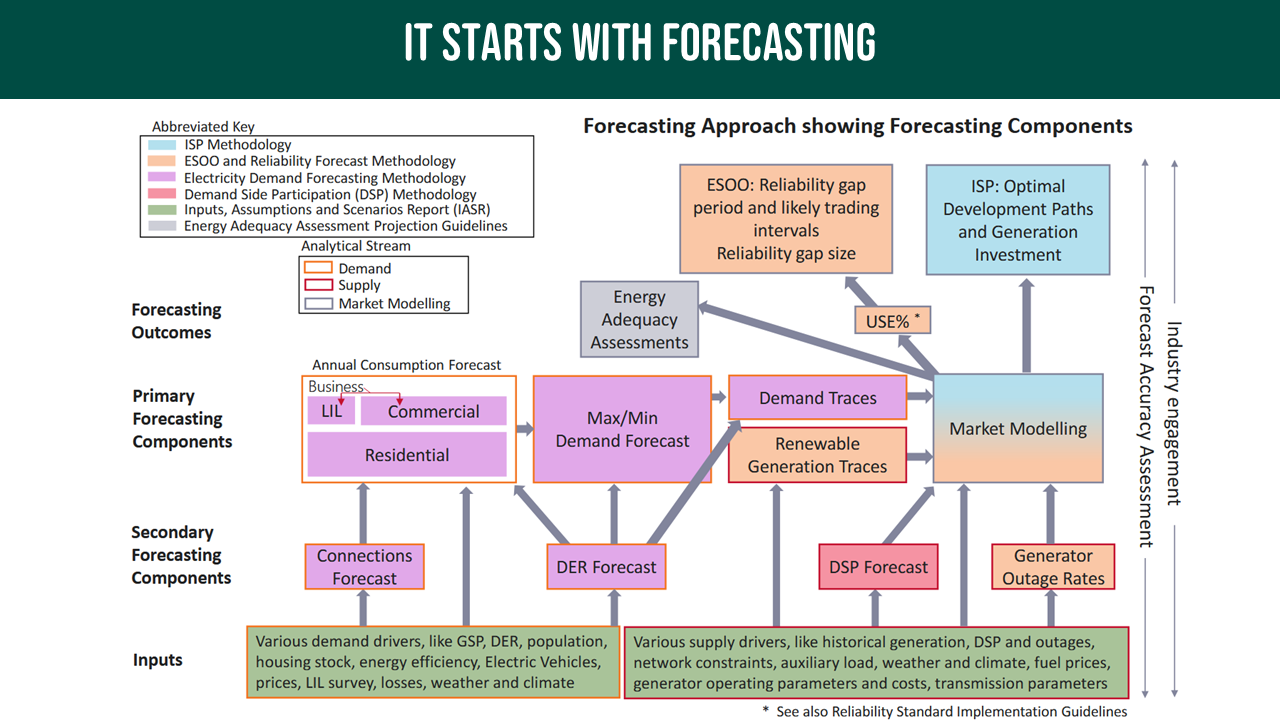
image from AEMO forecasting approach
Forecasting is foundational. AEMO looks at demand patterns, weather, rooftop solar, outages and new connections.
One example shows how sensitive this is. A bank of cloud moved over Adelaide unexpectedly, rooftop solar dropped, forecasts were wrong, and the market became unstable.
That’s how sensitive the system is.
And This Is Changing
Forecasting is becoming more tricky because:
rooftop solar isn’t in the market. It is produced and used locally and the market caters for the net result. Therefore it needs to be predicted, especially when clouds pass briefly over large numbers of rooftops in a city.
distributed energy - batteries, hot water on timers or automation, electric vehicles and charging patterns and other smart home energy - is reacting to household priorities rather than market priorities.
more weather dependence. Wind and solar respond to the weather where generation used to be independent of it. AEMO has always forecast heating and cooling response to extremes of hot and cold weather but now our home comfort might also be responding to market signals or new behaviours like cooling the house when the solar panels are cranking out energy.
There’s now a strong push for greater visibility of what’s happening at the household level and some upcoming changes where retailers will be obliged or encouraged to provide information into the bidding cycle. AEMO is also putting more effort into short-term weather forecasting and real-time data, because small changes—like cloud cover—can have system-wide effects.**.
The Bid Stack (Merit Order)
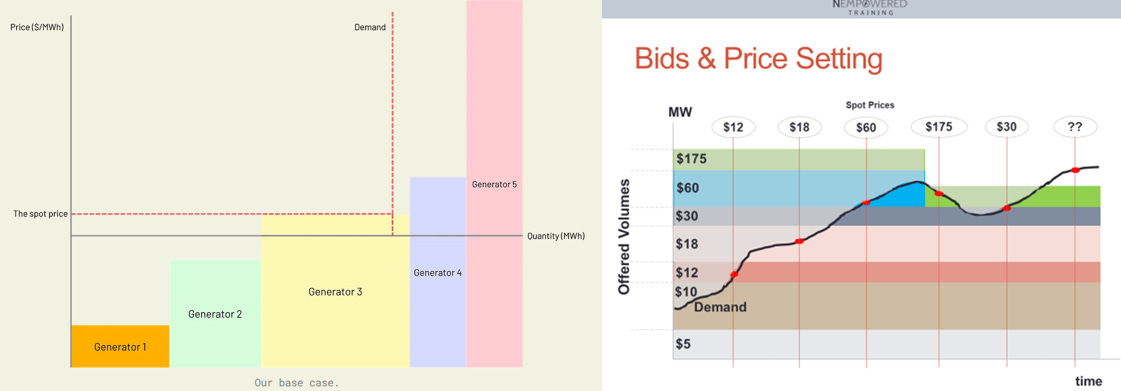
these graphs for demonstrating the bid stack seem most effective, the first from Alex Leemon at currently speaking who has a whole series on how the market works and the second from WattClarity through their series on bid stacks and price setting. In Alex’s graph, the area represents the $$ each generator bids to make, but they actually get paid at the strike price. If you tipped Alex’s stack on its side you would get something like a single sliver of the second graph. In the talk I also showed the way Shell education and AEMO describe bid stacks.
Generators submit bids for how much they will supply and at what price. These bids are stacked from lowest to highest cost.
AEMO works up the stack until demand is met. The last generator needed sets the price. And all are paid at the final price.
The system is supposed to incentivise generators to bid at their short-run marginal cost. This is mainly fuel and operating cost, not capital.
In practice, generators bid across multiple price bands. The bid stack changes as forecasts update and conditions shift.
Generators can rebid, for example if a unit fails or conditions change. The stack is always moving. Rebidding is allowed under specific rules, for example when conditions change or plant availability shifts, and it is monitored closely by regulators and analysts.
So the system is dynamic, not static.
This reflects a system designed around fossil fuels that can be dispatched whenever needed. Renewable and dispatchable generators include engines and turbines that run on renewable fuels like biomass, biogas and biodiesel, hydro-electricity and batteries.
Wind and solar which dominate the system we are now building are frequently called variable renewable energy (VRE) to emphasise that we have less control over where and when energy becomes available.
Some generators bid negative prices. Wind and solar do this to stay dispatched.
Coal can also bid negative to stay online and capture higher prices later.
What Prices Look Like for context
Prices range from a market floor of –$1,000/MWh to a market cap of $20,300/MWh but typical prices are $60–140/MWh. (other countries have different floors and caps and economists argue a lot about what works best)
Market floor: –$1,000/MWh
Market cap: $20,300/MWh
Typical:
$60–140/MWh
Retail prices are much higher once network and retail costs are included.
can be ~$600/MWh equivalent (including networks)
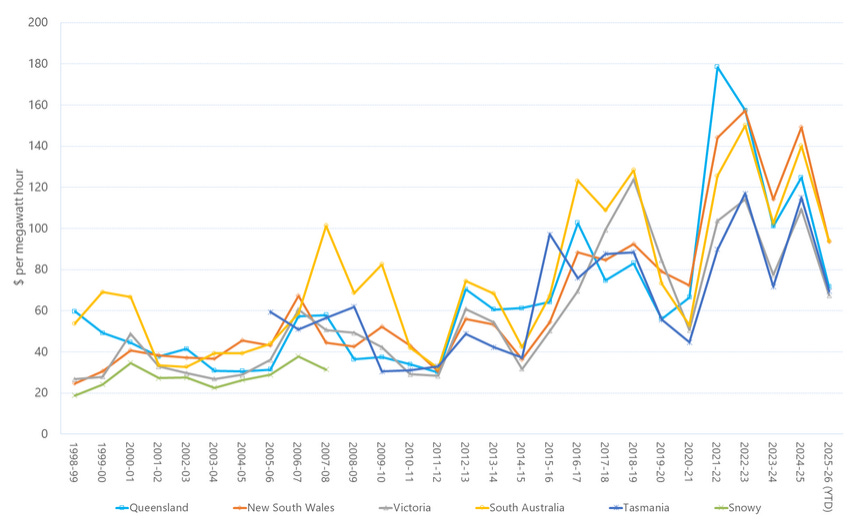
the AER tracks wholesale prices and many other market statistics in a variety of handy charts
Why Everyone Gets the Same Price
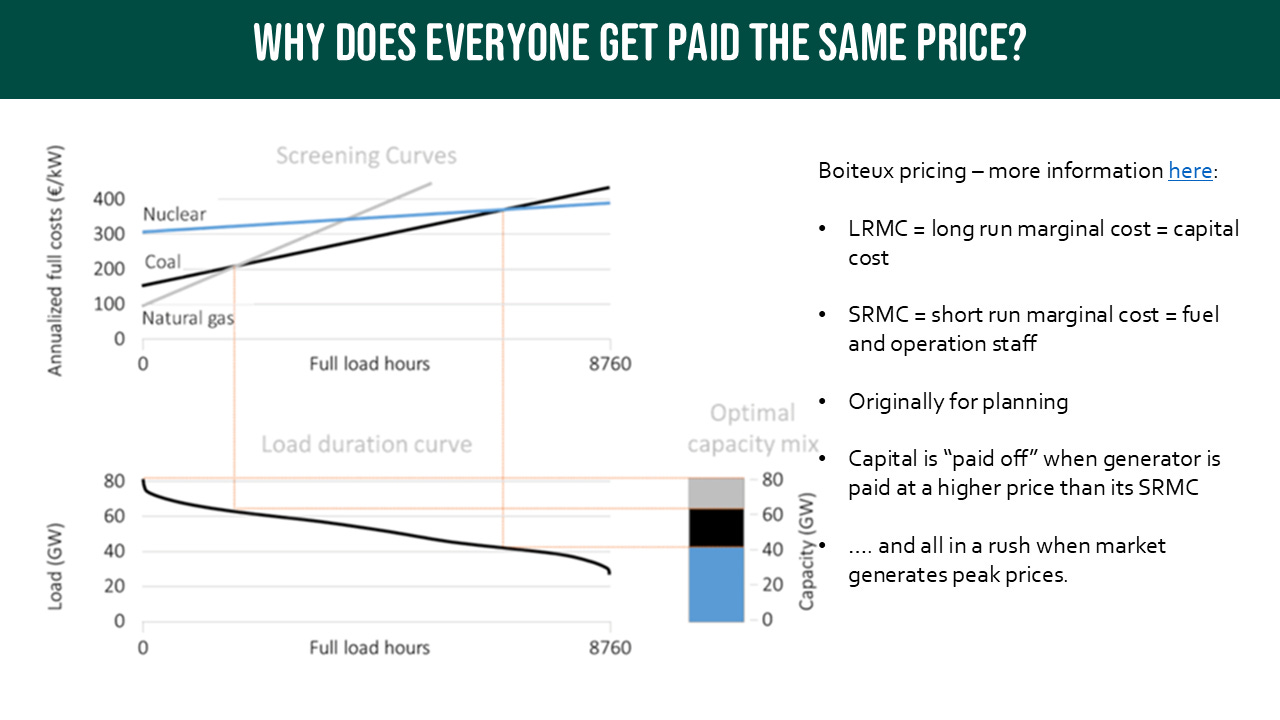
People often point out that electricity should be cheaper if we just paid generators the amount they bid. This is wrong but it is worth taking a moment to understand why the market has been designed in this way. I’ve written more on this here.
This design goes back to a 1950s economist, Marcel Boiteux who was operating within a planned energy system environment not a market one.
The idea is that different generators have different capital costs and running costs, so expensive-to-build assets like nuclear and coal need to be run for many hours of the year to provide lower cost electricity overall. In contrast expensive-to-run assets like engines and open cycle turbines are the cheapest asset to build if they are only going to be run on a few peak days of the year.
At the same time customers can’t tell which generator is providing their power so it makes sense that they pay the price of the last generator needed. This is marginal pricing.
The system design means lower-fuel-cost generators recover capital during higher price periods. But the market, even when it allows a very high spiky price at some times, does not seem to pay everyone back for all their capital investments. This is one reason secondary markets for hedges and futures are needed.
Nevertheless, this spot market sets the tone for the whole system because it is a competitive price-revealing mechanism.
This also explains why prices can be spiky. High prices are not an accident—they are part of how the system allows generators to recover their capital over time.
Why This Matters
This helps explain several things. Batteries respond to price by charging low and discharging high.
It also explains why small retailers struggle, as they need enough capital to manage payments and risk.
And it explains why demand-side participation is still relatively limited, even though it is growing and having more impact in the system.
The system is centralised and price-driven, while much of our energy transition is happening at the local level, mostly invisible to the centralised system.
What’s Changing
The system is becoming more dependent on weather and distributed energy. Forecasting is harder and prices are more volatile.
There is increasing focus on visibility and system reform.
Closing Thought
The spot market can feel abstract, but it is doing something very concrete. Every five minutes it decides what electricity is worth, who generates it, and how the system responds. Understanding it doesn’t require becoming an expert, but it does open up much better questions about prices, technology, and the role communities can play in shaping what comes next.
**please let us know in the comments if you are interested in diving deeper into any of these details.
Main links throughout the presentation plus more good learning references on this topic:
https://www.aemolearningacademy.aemo.com.au/#/courses
https://apps.apple.com/au/app/pocketnem/id593878165
https://wattclarity.com/other-resources/widgets/reneweconomy-widget/

https://shellenergy.com.au/energy-insights/bidstacks-wholesale-energy-education-series-2/
https://www.aer.gov.au/industry/registers/charts
https://docs.google.com/document/d/17cFkYaiQVLB_z2CuVQB2udSjWSuqgsdBZvfNh1UwOPE/edit?usp=sharing (This is an earlier Boiteux lesson for my Thesis, but is incomplete)
From the commentators…
